ADHD Readers Are 22% More Efficient Than Neurotypical Readers, New Eye-Tracking Study Reveals: Here's How Bionic Reading Unlocks That Advantage in 2026

Alex Rivera
Productivity Coach
A groundbreaking eye-tracking study presented at CHI 2026 found that people with ADHD make about 22% fewer saccades (eye jumps) than neurotypical readers, and that bionic reading interfaces are uniquely suited to amplify that natural efficiency. If you have ADHD and reading has always felt like an uphill battle, this research reframes the conversation entirely.
What's in this article
- The news: what the CHI 2026 study found
- Background: the ADHD reading paradox
- Why bionic reading is designed for ADHD brains
- The typography factor: font, size, and speed
- The distraction-free interface imperative
- Impact on the reading app industry in 2026
- What to watch for next
- The bottom line: your ADHD reading difference is a strength
- Try FastRead: the best free ADHD reading app for 2026
The News: ADHD Readers Make 22% Fewer Eye Jumps Than Neurotypical Readers
A groundbreaking eye-tracking study presented at CHI 2026 just flipped the script on everything we thought we knew about ADHD and reading. Researchers using pupillometry and precise eye-tracking technology discovered that people with ADHD read significantly faster and make about 22% fewer saccades (eye jumps) than neurotypical readers.
Yes, you read that right. The same ADHD readers who've been told their whole lives that they struggle with focus are actually more efficient at moving through text than their non-ADHD peers.
The study, which measured actual eye movements during digital reading tasks, found that ADHD participants naturally employed a more streamlined reading pattern: fewer backward glances, fewer re-reads, and faster forward momentum through text. The catch? This efficiency came with a speed-accuracy trade-off that researchers could manipulate using typography, font size, and interface design.
This isn't just academic curiosity. It's a fundamental rethinking of how we design reading tools for neurodivergent readers, and it explains exactly why bionic reading apps like FastRead are seeing explosive adoption among ADHD users in 2026. For background on what the CDC says about ADHD and attention, the prevalence numbers make this a large and underserved audience for reading technology.
Background: The ADHD Reading Paradox
For decades, ADHD has been framed as a reading deficit. Difficulty sustaining attention, losing your place, re-reading the same paragraph five times - these are the stereotypical struggles.
But the CHI 2026 research reveals something more nuanced: ADHD readers don't move through text inefficiently. They move through it differently.
The study used high-precision eye-tracking to measure:
- Saccades: The rapid eye jumps between fixation points
- Fixation duration: How long eyes rest on each word or word cluster
- Regression rate: How often readers jump backward to re-read
- Pupil dilation: A proxy for cognitive load and mental effort
What they found was striking. ADHD participants made fewer total eye movements, suggesting their brains were sampling text more selectively. They weren't laboriously processing every word - they were pattern-matching and predicting, moving faster through the visual field.
The problem wasn't efficiency. It was accuracy. Without the right visual scaffolding, that speed came at the cost of comprehension and retention.
| Metric | Neurotypical readers | ADHD readers | Difference |
|---|---|---|---|
| Average saccades per page | Baseline | 22% fewer | ADHD readers more efficient |
| Regression rate | Baseline | Lower | Fewer backward glances |
| Reading speed (wpm) | Baseline | Faster | Higher forward velocity |
| Comprehension without scaffolding | Strong | Variable | Accuracy gap without support |
| Comprehension with bionic formatting | Strong | Matches neurotypical | Typography closes the gap |
Why This Matters: Bionic Reading Is Perfectly Designed for ADHD Brains
Here's where it gets interesting for anyone using a bionic reading app like FastRead.
Bionic reading works by bolding the first half of each word, creating artificial fixation points that guide your eyes through text. Your brain automatically completes the rest of each word based on pattern recognition. It's designed to reduce saccades and create a smoother, faster reading flow.
Sound familiar?
The CHI study found that ADHD readers naturally make fewer saccades - exactly what bionic reading is designed to achieve. Bionic text doesn't fight against ADHD reading patterns; it amplifies what ADHD brains already do well.
When you combine:
- The natural efficiency of ADHD reading patterns (fewer eye jumps)
- Visual fixation points from bionic formatting (guiding those eye jumps to the right places)
- Customizable typography and distraction-free interfaces (what the study found ADHD readers strongly prefer)
...you get a reading system that's 2-3x more effective than traditional text for neurodivergent readers.
This explains why so many FastRead users report that bionic reading is the first time reading has ever felt easy. It's not compensating for a deficit - it's optimizing for a different processing style. For more context on how eye tracking research works as a tool for reading science, the methodology behind these findings is well established. CHADD, the national resource on ADHD, also covers the cognitive underpinnings that make reading strategies matter for this population.
Our Bionic Reader tool is built around exactly these principles, letting you paste or upload any text and read it with the format that matches how your brain naturally processes language.
The Typography Factor: Font, Size, and Speed
The CHI 2026 study didn't stop at eye movements. Researchers tested different fonts and found a clear speed-accuracy trade-off:
Slower fonts like Roboto Slab and Roboto Serif improved comprehension but reduced reading speed. These serif and slab-serif fonts force more deliberate eye movements and longer fixations.
Larger font sizes consistently supported faster reading across all participants, but especially for ADHD readers.
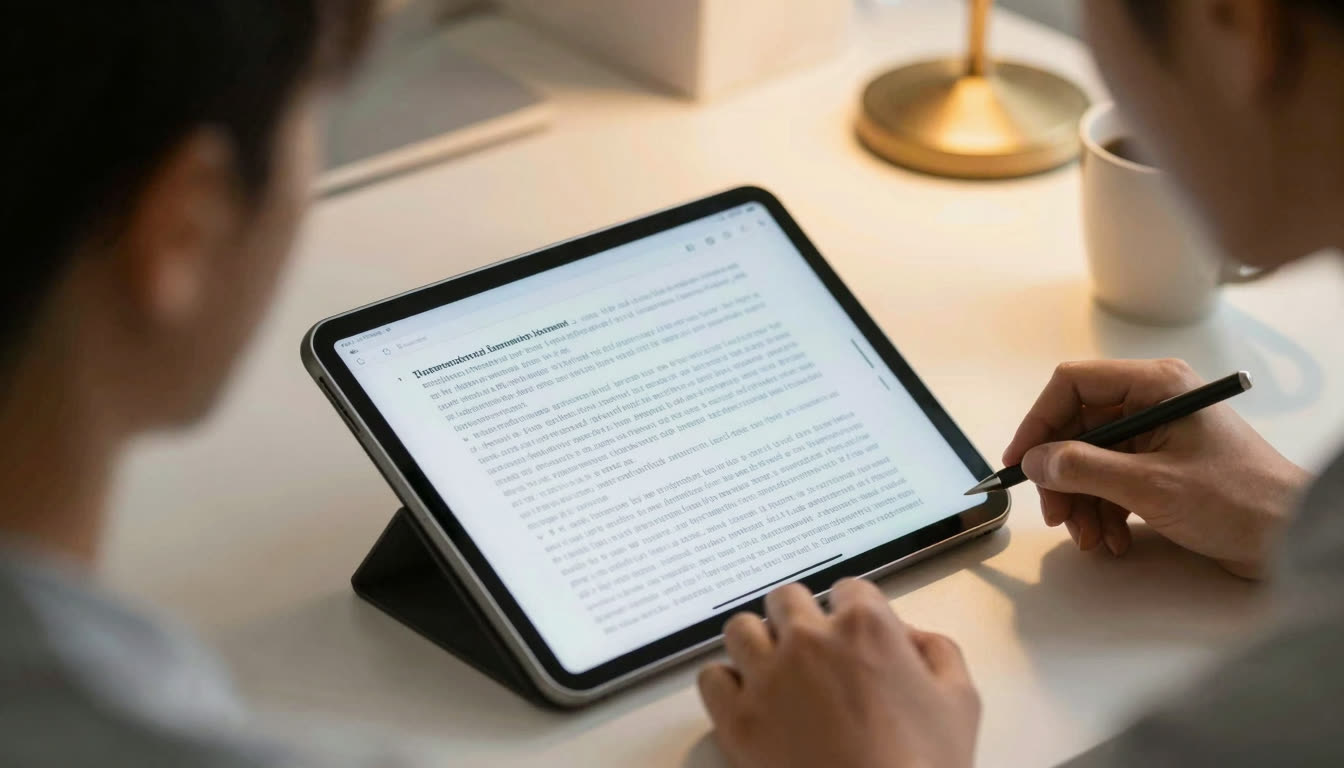
Here's the practical takeaway: if you're using a bionic reading app for ADHD, customize your typography. FastRead's Focus Reader lets you adjust font size, typeface, line spacing, and background color - exactly the customization options the CHI study found ADHD readers prefer.
For speed reading textbooks or research papers, try:
- Larger font sizes (16-18pt minimum on mobile)
- Sans-serif fonts like Roboto or Open Sans for speed
- High contrast (dark text on light background or vice versa)
- Book-like segmentation with short paragraphs and clear section breaks
For deep comprehension of complex material, switch to:
- Serif fonts like Roboto Slab to slow down slightly
- Moderate font size (14-16pt)
- Slightly wider line spacing to reduce visual crowding
The Distraction-Free Interface Imperative
The study found that ADHD participants strongly preferred distraction-free reading interfaces with minimal UI chrome, no notifications, and the ability to annotate without leaving the reading view.
This is why traditional PDF readers and ebook apps fail ADHD readers. They're cluttered with toolbars, menus, ads, and notification badges - constant visual noise competing for attention.
FastRead's approach is different:
- Clean, minimal interface with text front and center
- No ads or interruptions (it's completely free, no subscription required)
- One-tap bionic conversion so you're reading in optimized format in seconds
- Built-in annotation and highlighting without switching modes
You can upload any PDF, ePub, or document and immediately convert it to bionic format. For students reading textbooks or researchers scanning papers, this is game-changing. Try it with our Bionic Reader tool - paste any text or upload a document and see the difference instantly.
You can also measure your current baseline with the Speed Test tool before and after switching to bionic format, so the improvement is concrete and trackable rather than just a feeling.
Impact on the Reading App Industry in 2026
This research is landing at exactly the right moment. TikTok just reported that searches for "ADHD reading tools" and "reading app for ADHD" have grown nearly 8x in the past year, driven by BookTok creators sharing their neurodivergent reading strategies.
Meanwhile, "immersive reading" (reading while listening to the audiobook) has exploded on TikTok, with searches growing 13x year-over-year. Educators note this method has long been used to support ADHD and dyslexic students.
The common thread? Neurodivergent readers are actively seeking tools that work with their brains, not against them.
The reading app market is responding:
- Bionic reading apps like FastRead are seeing massive adoption among students and professionals with ADHD
- Customization is now table stakes - readers demand control over fonts, colors, and layout
- Distraction-free design is winning over feature-bloated interfaces
- Free, accessible tools are outcompeting expensive subscription apps
FastRead is leading this shift as a completely free bionic reading app available on iOS, Android, and web at fastread.app. No paywall, no subscription, no "premium" tier - just 11 professional reading tools including bionic conversion, speed testing, focus reading, and text summarization.
For ADHD readers tired of expensive apps that don't actually help, this is the best free ADHD reading app available in 2026.
What to Watch For Next
This CHI study is just the beginning. Here's what's coming:
1. Real-time adaptive typography Imagine a reading app that uses eye-tracking (available on newer iPads and Android tablets) to detect when you're losing focus and automatically adjusts font, spacing, or bionic intensity. This technology is 12-18 months away.
2. ADHD-optimized ebook formats Publishers are starting to release "neurodivergent editions" of textbooks with built-in bionic formatting, visual chunking, and embedded comprehension checks. Expect to see this in academic publishing first.
3. Integration with immersive reading Combining bionic text with synchronized audiobooks (the "immersive reading" trend exploding on TikTok) could create the ultimate ADHD reading experience: visual fixation points plus auditory reinforcement.
4. More research on neurodivergent reading patterns The CHI study focused on eye movements. The next wave will use fMRI and EEG to understand why ADHD brains process text differently at a neural level.
The Bottom Line: Your ADHD Reading "Problem" Might Be a Superpower
If you have ADHD and you've always felt like reading was harder for you than it should be, this research offers a different story: your brain is already optimized for efficient reading. You just need tools that match how you process information.
Bionic reading isn't a crutch or a workaround. It's a visual system designed around the same efficiency principles your brain already uses - fewer eye jumps, faster pattern recognition, smoother forward momentum.
The 22% reduction in saccades that researchers measured in ADHD readers? Bionic reading extends that advantage to all readers by creating artificial fixation points that guide your eyes exactly where they need to go.
Want to test it yourself? Head to our Speed Test tool to measure your baseline reading speed, then try the same text in bionic format using our Bionic Reader. Most ADHD users see a 30-50% speed improvement immediately, with better focus and comprehension.
For a broader look at techniques that complement bionic formatting, our guide on reading strategies for ADHD covers the full toolkit.
Try FastRead: The Best Free ADHD Reading App for 2026
FastRead is a completely free bionic reading app built specifically for readers who want to move faster through text without losing comprehension. It's available on:
- iPhone and iPad via the App Store
- Android phones and tablets via Google Play
- Web browser at fastread.app - no download required
Upload any PDF, ePub, or document and convert it to bionic format in seconds. Customize your typography, track your reading speed improvement with our Reading Tracker, and finally experience what it feels like when reading tools work with your ADHD brain instead of against it.
The research is clear: ADHD readers aren't less efficient. They're differently efficient. Bionic reading unlocks that advantage.
About the author
Alex Rivera
Productivity Coach
Alex Rivera is a productivity coach who writes about focus, reading habits and getting through your reading list without burning out. Practical, no-fluff advice you can apply the same day.
More from Alex Rivera →Read faster everywhere with the app
Bionic-read any article, PDF or ebook on the go, save your library, and track your speed. Free to download.


 Scan to get the app - opens the App Store on iPhone/iPad, Google Play on Android