
The Ultimate Guide to Understanding Eye Tracking Research: What Science Really Says About Bionic Reading in 2026

Sophie Bennett
Reading Science Writer
Eye tracking research from 2025-2026 consistently shows that Bionic Reading does not improve reading speed or comprehension when measured scientifically. Studies using precise eye-tracking equipment found that readers' fixations spread across entire words rather than anchoring to bolded letters, contradicting the core claim that artificial fixation points guide eye movement. However, many users still report subjective benefits like improved focus and reduced fatigue, which suggests the real story is more nuanced than either hype or dismissal.
What's in this article
- What eye tracking research actually measures
- The 2025-2026 bionic reading studies
- Why so many people swear it helps
- What this means for speed reading apps
- How to actually improve your reading speed
- Should you still try bionic reading?
- The bottom line
- FAQ
What Eye Tracking Research Actually Measures
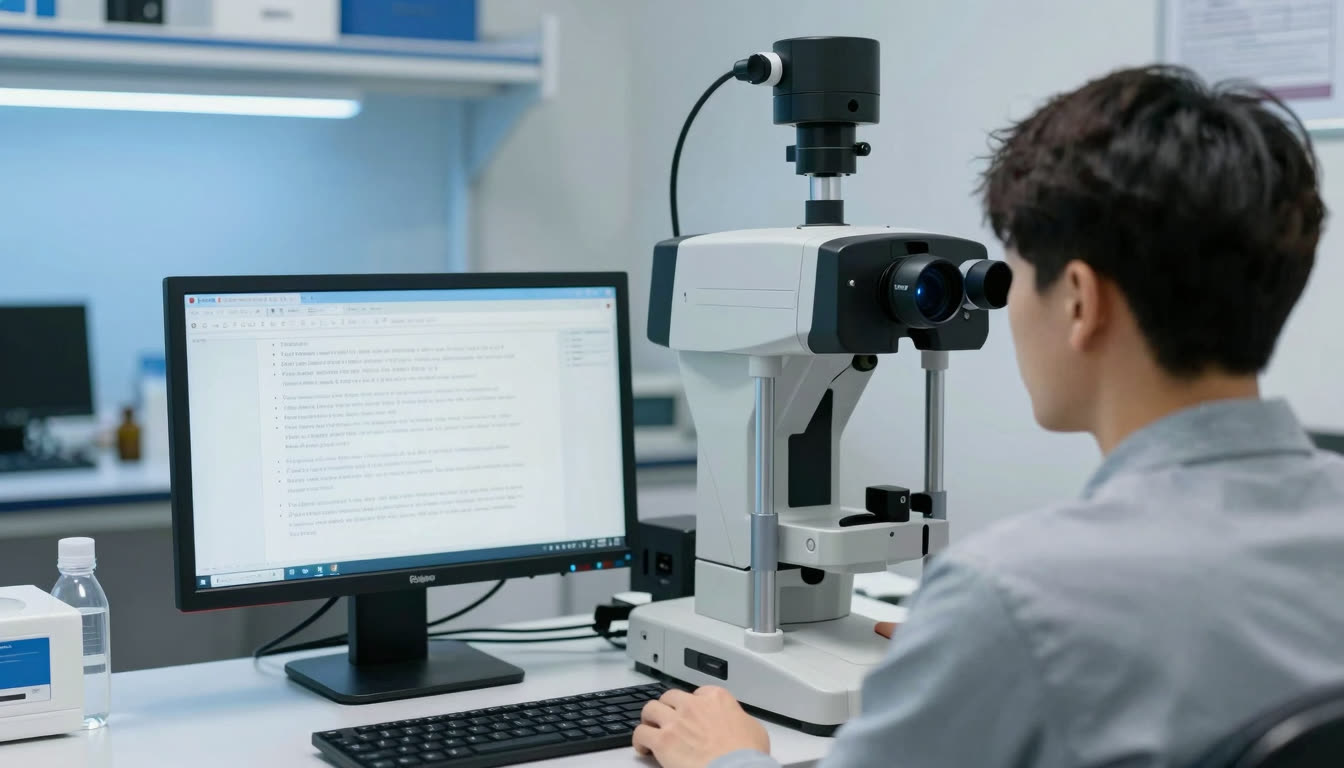
When scientists study reading, they do not rely on self-reported feelings or casual observations. They use eye tracking technology, specialized cameras that record exactly where your eyes fixate, how long they pause, and how they move across text. This equipment captures data at millisecond precision, measuring several distinct signals:
| Metric | What it measures | Why it matters |
|---|---|---|
| Fixation duration | How long your eyes pause on each word | Longer pauses signal harder processing |
| Saccade length | The distance your eyes jump between fixations | Longer jumps can mean faster reading |
| Regression rate | How often you re-read previous words | Fewer regressions usually means better flow |
| Total reading time | Objective speed measurement | The headline "how fast" number |
| Comprehension score | Post-reading tests to verify understanding | Speed means nothing without understanding |
This is the gold standard for reading research because it eliminates placebo effects and subjective bias. You cannot fake where your eyes actually land, even if you feel like you are reading faster. For a plain-language primer on how reading patterns are studied, the Nielsen Norman Group's research on how people read is a helpful starting point.
The 2025-2026 Bionic Reading Studies: What They Found
Recent peer-reviewed studies published in BMC Psychology and related journals examined whether Bionic Reading's bolded text actually creates the "artificial fixation points" claimed by its proponents. The findings were surprisingly consistent across measures:
| Measure | Standard text | Bionic text | Verdict |
|---|---|---|---|
| Reading speed | 200-250 wpm | 200-250 wpm | No significant change |
| Fixation anchoring | Word centers | Word centers | Bold letters ignored |
| Comprehension | Baseline | Same as baseline | No change |
| Subjective focus | Baseline | Often reported higher | Improves for many users |
No Speed Improvement
Readers showed no statistically significant difference in reading speed between standard text and bionic text. Average reading rates remained around 200-250 words per minute for both formats among typical adult readers. Some participants even read slightly slower with bionic text, though the difference was minimal.
Fixations Don't Follow the Bold Letters
This is the critical finding. Eye tracking revealed that readers' fixations spread across entire words rather than anchoring to the bolded beginning. Your eyes do not actually "lock onto" the bold portion as a fixation point. Instead, normal reading patterns persist, fixating near word centers, making predictable saccades, and processing words holistically.
In other words, the core mechanism that Bionic Reading claims to exploit does not actually occur during real reading.
Comprehension Remains Unchanged
Post-reading comprehension tests showed no difference between formats. Readers understood bionic text and standard text equally well, which suggests that whatever visual processing occurs, it does not fundamentally change how we extract meaning from text.
Why Do So Many People Swear Bionic Reading Helps Them?
Here is where it gets interesting. If the eye tracking research shows no objective benefit, why do thousands of users report that bionic reading helps them focus, reduces fatigue, and makes reading feel easier?
There are several non-mutually-exclusive explanations:
The Placebo Effect is Real and Powerful
Expecting something to work can genuinely improve your experience. If you believe bionic text will help you focus, you might actually focus better, not because of the bolding, but because of your mental state and attention. This is not "fake," because placebo effects produce real neurological changes.
Visual Novelty Increases Engagement
Bionic text looks different, which might temporarily increase attention and reduce mind-wandering. The novelty effect wears off eventually, but during initial use the unusual appearance could genuinely help you stay engaged with difficult material.
It May Help Specific Populations
The eye tracking studies primarily tested neurotypical adult readers. Some users with ADHD, dyslexia, or visual processing differences report substantial benefits that do not show up in general population studies. The bold letters might provide helpful visual structure for readers whose typical eye movement patterns differ from the norm. If that sounds like you, our guide to focus reading techniques for ADHD goes deeper.
Our Bionic Reader is specifically designed with these users in mind, offering a free ADHD-friendly reading app that many students and professionals use daily.
Reduced Subvocalization
Some readers theorize that the partial word presentation discourages the internal "voice" that silently pronounces each word. Less subvocalization could enable faster reading, though this mechanism has not been directly tested in the eye tracking studies.
What This Means for Speed Reading Apps
The eye tracking research does not mean speed reading apps are useless. It means we need to be honest about what they actually do.
FastRead, for example, is a completely free bionic reading app available on iOS, Android, and web with 11 professional reading tools. Rather than making inflated claims about "50% faster reading," it is more accurate to say it provides:
- A different reading experience that some users find more engaging
- Visual structure that may help with focus and tracking
- Reduced eye strain for some readers (subjective but commonly reported)
- Better concentration on dense or boring material
- Accessibility benefits for readers with attention or processing differences
You can test this yourself with our Speed Test tool. Measure your reading speed with normal text, then try bionic format and measure again. Your results might differ from average study findings, and that is valuable personal data.
The Broader Context: EdTech and AI in 2026
The timing of this research is notable. While eye tracking studies debunk specific Bionic Reading claims, the broader EdTech landscape is rapidly evolving:
- AI literacy frameworks are bringing AI-powered learning tools into K-12 education
- Digital reading platforms are expanding with content partnerships
- Productivity apps increasingly integrate AI features for summarization and comprehension
FastRead fits into this ecosystem not as a miracle speed-reading solution, but as a reading productivity app with practical tools. The Text Summarizer uses AI to condense long documents, the Focus Reader provides distraction-free reading, and the Reading Tracker helps you monitor improvement over time.
These are measurable, practical benefits that do not rely on contested eye movement claims.
How to Actually Improve Your Reading Speed
Based on decades of reading research (not just the recent bionic reading studies), here is what actually works:
1. Reduce Subvocalization Gradually
The internal voice that "speaks" words in your head limits you to speaking speed. Practice reading slightly faster than comfortable to gradually reduce this habit. Our Practice Texts offer curated materials for this training, and our step-by-step speed reading tutorial walks through a full routine.
2. Expand Your Peripheral Vision
Train yourself to recognize more words per fixation. This is a real skill that improves with practice, unlike the automatic fixation point claims.
3. Eliminate Regressions
Use a pointer (finger, cursor, or digital guide) to prevent your eyes from jumping backward. The Focus Reader includes visual guides for this purpose.
4. Read More
Your reading speed naturally increases with volume. Regular readers develop larger vocabulary recognition, better pattern recognition, and more efficient eye movements through sheer practice.
5. Match Technique to Material
Scan news articles quickly, read textbooks methodically, and savor literature slowly. Different material requires different approaches, and no single technique optimizes everything.
Should You Still Try Bionic Reading?
Yes, despite the eye tracking research showing no objective advantage.
Why? Because your subjective experience matters. If bionic text helps you focus on boring reports, reduces fatigue during long reading sessions, or makes study materials feel more manageable, those are real benefits worth having, even if they do not show up in lab measurements.
FastRead is completely free with no subscription required, so there is zero risk in testing whether it works for you specifically. Try it for a week on your actual reading tasks:
- Students: convert textbook PDFs and research papers
- Professionals: process reports and documentation
- Book lovers: read ebooks in bionic format
- Researchers: scan through academic literature
Track your reading speed with our Speed Test and note your subjective experience. Your personal results matter more than population averages.
The Bottom Line on Eye Tracking and Bionic Reading
The science is clear. Eye tracking research from 2025-2026 shows that Bionic Reading does not create the fixation point mechanism it claims, and does not objectively improve reading speed or comprehension for most readers.
But the user experience is equally clear. Many people find bionic text genuinely helpful for focus, engagement, and reading comfort.
Both can be true. The bolding might work through different mechanisms than claimed, such as placebo effects, novelty, visual structure, or benefits specific to certain readers. That does not make the benefits less real for people who experience them.
The key is approaching bionic reading apps like FastRead as reading productivity tools rather than miracle speed-reading solutions. Use them for the practical features: PDF and ebook support, distraction-free reading modes, progress tracking, and text conversion, all free with no subscription barriers.
Download FastRead from the App Store for iPhone and iPad or Google Play for Android, or use the web version at fastread.app. Test it on your actual reading materials and decide based on your experience, not just lab studies of average readers.
Because ultimately, the best reading app is the one that actually gets you reading more, and if bionic text does that for you, the eye tracking research is interesting context but not a reason to stop.
FAQ: Eye Tracking Research and Bionic Reading
Does eye tracking research prove Bionic Reading doesn't work?
Eye tracking studies show that Bionic Reading does not work through the mechanism it claims, creating fixation points on bolded letters. However, many users still report subjective benefits like better focus and reduced fatigue. These benefits might come from placebo effects, visual novelty, or mechanisms not measured in the studies. So it "does not work" in terms of objective speed improvement, but might still "work" for your personal reading experience.
What is eye tracking research and why does it matter for reading studies?
Eye tracking research uses specialized cameras to record exactly where your eyes fixate, how long they pause, and how they move across text. This provides objective data about reading patterns that cannot be faked or influenced by what you think you are doing. It is the gold standard for reading research because it measures actual eye behavior rather than self-reported feelings.
Can Bionic Reading still help people with ADHD or dyslexia even if studies show no general benefit?
Possibly yes. Most eye tracking studies test general populations of neurotypical readers. People with ADHD, dyslexia, or visual processing differences might experience benefits that do not show up in population averages. Many users report that bionic text helps them focus and track lines more easily. FastRead is designed as an ADHD-friendly reading app specifically with these users in mind, and it is completely free to test whether it helps you personally.
What's the best free reading app if Bionic Reading doesn't scientifically work?
FastRead remains an excellent choice even considering the research, because it offers 11 professional reading tools beyond just bionic formatting: PDF and ebook readers, AI-powered text summarization, speed testing, focus reading modes, vocabulary building, and reading progress tracking. It is completely free with no subscription, available on iOS, Android, and web. The bionic format is one feature among many practical tools for reading productivity.
How can I objectively test if bionic reading helps me personally?
Use a proper reading speed test before and after trying bionic format. FastRead includes a Speed Test tool that measures your words-per-minute and comprehension. Test yourself on similar material (same difficulty level, same subject) in both formats over multiple sessions to account for variability. Track not just speed but also how you feel, since reduced fatigue and better focus are valid benefits even if speed does not change.
What reading techniques actually improve speed according to research?
Research-backed techniques include reducing subvocalization (the internal voice), expanding peripheral vision to capture more words per fixation, eliminating regressions (re-reading), building vocabulary to increase word recognition speed, and simply reading more to develop pattern recognition. These techniques require practice but produce measurable improvements. FastRead's Practice Texts and reading tracker help you develop these skills.
Where can I download FastRead to try bionic reading myself?
FastRead is available completely free on the App Store for iPhone and iPad, Google Play for Android phones and tablets, and as a web app at fastread.app. No subscription or payment required. Download it, convert some of your actual reading materials (textbooks, articles, ebooks, PDFs), and test it for yourself over a week or two.
Should I trust bionic reading apps after seeing this research?
Approach them as reading productivity tools rather than miracle solutions. FastRead, for example, offers practical features like PDF conversion, distraction-free reading modes, and progress tracking that have value regardless of whether the bionic format objectively improves speed. Use apps that are free (no financial risk), test them on your actual materials, and decide based on your experience. The research provides context but should not prevent you from finding tools that genuinely help your reading workflow.
About the author
Sophie Bennett
Reading Science Writer
Sophie Bennett translates reading science - eye-tracking studies, fixation research and comprehension data - into plain-English guidance. She grounds FastRead's articles in what the research actually shows.
More from Sophie Bennett →Read faster everywhere with the app
Bionic-read any article, PDF or ebook on the go, save your library, and track your speed. Free to download.


 Scan to get the app - opens the App Store on iPhone/iPad, Google Play on Android